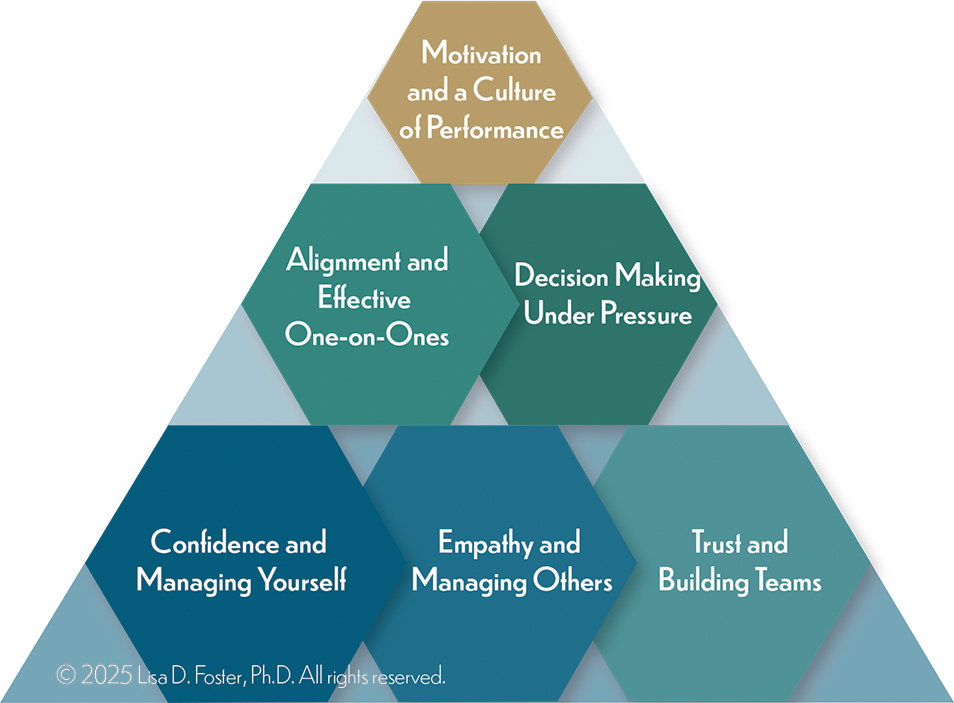
A Leadership Skills Framework that Works as a System to Improve Results without Force or Pressure
Leadership skills work together as a system to achieve the results your organization needs, and that every leader needs to be more effective. These skills build on one another and create a system for improving motivation, engagement, and performance.
If one of your leadership skills is undeveloped, the whole system weakens.
Leadership rarely fails because people don’t care or aren’t trying hard enough. More often, it fails because leaders are operating without a clear system for understanding what’s really happening on their teams — and what to do about it.
If you’re feeling more leadership stress than you should, you’re not alone.
You might recognize some of these experiences:
- Your team is capable, but team performance feels uneven
- You’re dealing with stress, friction, or disengagement you can’t quite name
- You explain direction clearly, yet people don’t seem to hear you
- You’re more involved in day-to-day issues than you want to be
These aren’t personality flaws or motivation problems. They’re usually signs that one or more core leadership skills are underdeveloped — and that the system those skills create isn’t working as well as it could.
Leadership Works Best as a System
Leadership is a set of skills that work together to give people what they need to be at their best without compromising standards. When your team is engaged and motivated, even ambitious goals are possible.
When one skill is weak, the whole system feels harder than it needs to be.
When the system is strong, leadership becomes steadier, more predictable, and far less stressful — for you and for your team. Teams become motivated. Team performance improves. Leadership stress goes down.
Over time, I’ve found that effective leadership consistently rests on six core skills, grouped into two layers:
Foundational Leadership Skills
These skills create stability, trust, and psychological safety.
- Confidence and Managing Yourself — staying steady under pressure so emotions don’t drive decisions
- Empathy and Managing Others — understanding what people actually need to do their best work
- Trust and Building Teams — creating fairness, reliability, and ownership so teams collaborate instead of protecting themselves
When these skills are weak, leaders often experience stress, friction, silence, or confusion — even when everyone is capable.
Explore the Foundational Leadership Skills
Application Leadership Skills
These skills turn clarity into execution.
- Alignment and Effective One-on-Ones — where strategy meets execution, information flows reliably, and issues surface early
- Decision Making Under Pressure — a process for sound judgment when stakes are high and information is incomplete
- Motivation and a Culture of Performance — supporting team needs so that people take ownership without constant oversight
Even strong leaders can feel stuck if these skills aren’t in place. The flow of information is unreliable. Decisions feel difficult, isolating, or ineffective. Execution is slow and there are pockets of resistance.
Explore the Application Leadership Skills
How to Find Your Next Step
You don’t need to master all six skills at once. In fact, most leaders get the best results by starting with the skill that feels hardest right now.
Here are a few signals that can help you self-diagnose:
- If leadership feels stressful or emotionally draining, start with Confidence and Managing Yourself
- If people seem disengaged, defensive, or distant, Empathy and Managing Others is often the missing piece
- If teams don’t collaborate well or take ownership, look at Trust and Building Teams
- If execution drifts or surprises keep popping up, focus on Alignment and Effective One-on-Ones
- If decisions feel more difficult than they should, Decision Making Under Pressure can make an immediate difference
- If results depend too much on you pushing, explore Motivation and a Culture of Performance
Building your leadership framework makes it easier to address root causes instead of reacting to symptoms. That’s when the team starts learning and trusting each other, and your team starts to grow.
What Changes When the Leadership Framework Is Working
When these skills reinforce one another, something important shifts.
- Teams speak up earlier
- Problems are solved before they escalate
- Ownership replaces compliance
- Leaders get time, energy, and perspective back
Performance improves — not because people are pressured harder, but because the environment supports good work.
This is the difference between managing outcomes and building a leadership system that produces them.
If leadership has felt harder than it should, you don’t need a new personality or more effort. You need the right skills, applied in the right order.
Explore the Leadership Framework and choose your next step.
Curious where to focus next as a leader?
The Leadership Skills Audit offers a quick, practical snapshot of the skills that matter most as your role and responsibilities grow.

3 comments